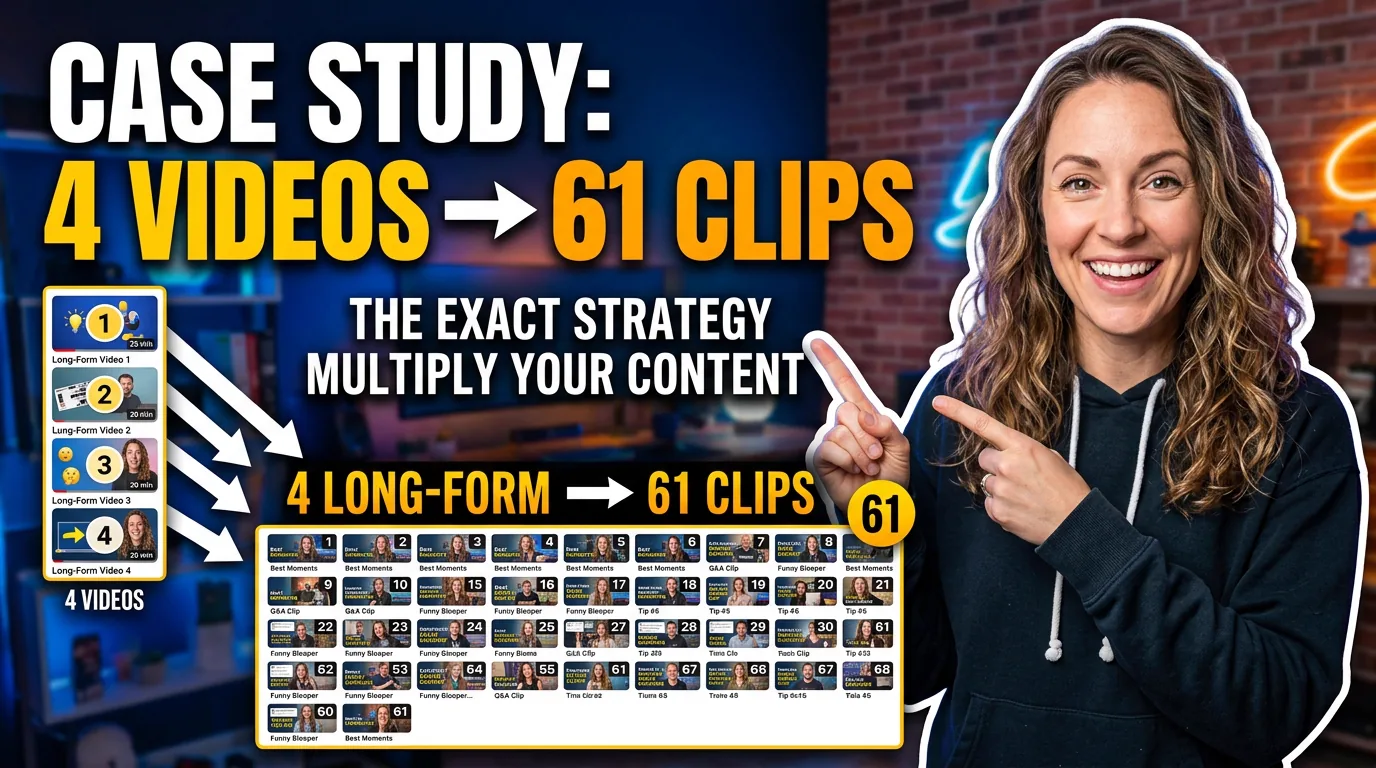
Case Study: How One Creator Turned 4 Videos Into 61 Clips
This is a walkthrough of a repurposing workflow run by a creator with a small library — four long-form videos, between 22 and 41 minutes each, all in the same subject area. The goal was to build a short-form presence without producing anything new.
Three months later: 61 clips published, and the short-form channel had become the primary source of new subscribers. Below is what actually happened, including the parts that did not work.
The starting position
The source library was small on purpose. The creator had published four videos over eighteen months, each reasonably dense — no filler segments, no long digressions. That density turned out to matter more than the count.
The first attempt was the obvious one: watch the videos, mark the good bits, cut them. That produced nine clips in two weeks and stalled. The bottleneck was not the cutting — it was the deciding.
The change that made it work
The workflow was restructured around a single rule: the transcript comes first, the video second.
- •Pull the transcript for each of the four videos.
- •Read it, not the footage. Highlight any passage that is a complete, self-contained claim.
- •Score each candidate on three things: does it stand alone without context, is it specific rather than general, does it have a clear ending.
- •Only then open the timeline.
This moves the expensive step — deciding — into text, where it is roughly four times faster. The four transcripts produced 74 candidates. Fifteen were dropped at the edit stage for framing or audio reasons, leaving 61 that shipped.
The insight is not subtle, but it is the whole case: judging a passage is far cheaper in a transcript than in a timeline. The creator stopped scrubbing and started reading.
What the clips looked like
The 61 clips broke down into three shapes, and the mix was deliberate:
- •The self-contained point (~45s, 38 clips). One claim, one supporting example, done. The workhorse.
- •The specific number (~25s, 15 clips). "We cut this from eleven hours to forty minutes and here is the exact change." Anchored on a concrete figure, which makes them unusually shareable.
- •The contradiction (~60s, 8 clips). A passage that opens with something the audience probably believes and then disagrees with it. Fewest in number, highest engagement per clip.
Roughly a third of the self-contained points required a B-roll overlay to cover the fact that the speaker was referencing something on screen. That is a cost worth budgeting for: it is the difference between a clip that is understandable and one that is not.
What did not work
Two things are worth recording as failures.
Auto-selecting the loudest moments. Energy is not the same as substance. The passages with the most animated delivery were often the least self-contained, because excitement implies shared context. Every one of those clips under-performed the median.
Publishing a clip per day from the start. The library was four videos deep. That cadence exhausted the best material in three weeks and forced the weaker candidates into the schedule. Weekly, then twice-weekly once the back catalogue was rebuilt, performed better per clip.
The numbers, three months on
- •61 clips published over 13 weeks
- •Median completion rate roughly 1.8× that of the creator's pre-existing short-form attempts
- •The short-form channel drove the majority of new subscribers in the final month
- •Two clips accounted for about a fifth of total short-form views — consistent with the usual distribution, and a reminder that you cannot predict which ones
The specific figures matter less than their shape. The distribution was wide and unpredictable, which is an argument for publishing volume rather than optimising individual clips to death.
What generalises
Four things transferred cleanly and are worth stealing:
- •Read the transcript, cut the timeline. The deciding step is cheaper in text.
- •Four dense videos beat forty thin ones. Self-containment comes from the source, not the cut.
- •Three clip shapes, deliberately mixed. One workhorse shape keeps the schedule; the rare shape drives engagement.
- •Budget for B-roll overlays. A clip that references off-screen context is not actually self-contained.
The repurposing did not come from a tool. It came from recognising that selection was the bottleneck, and moving the selection into the medium where it is fast.