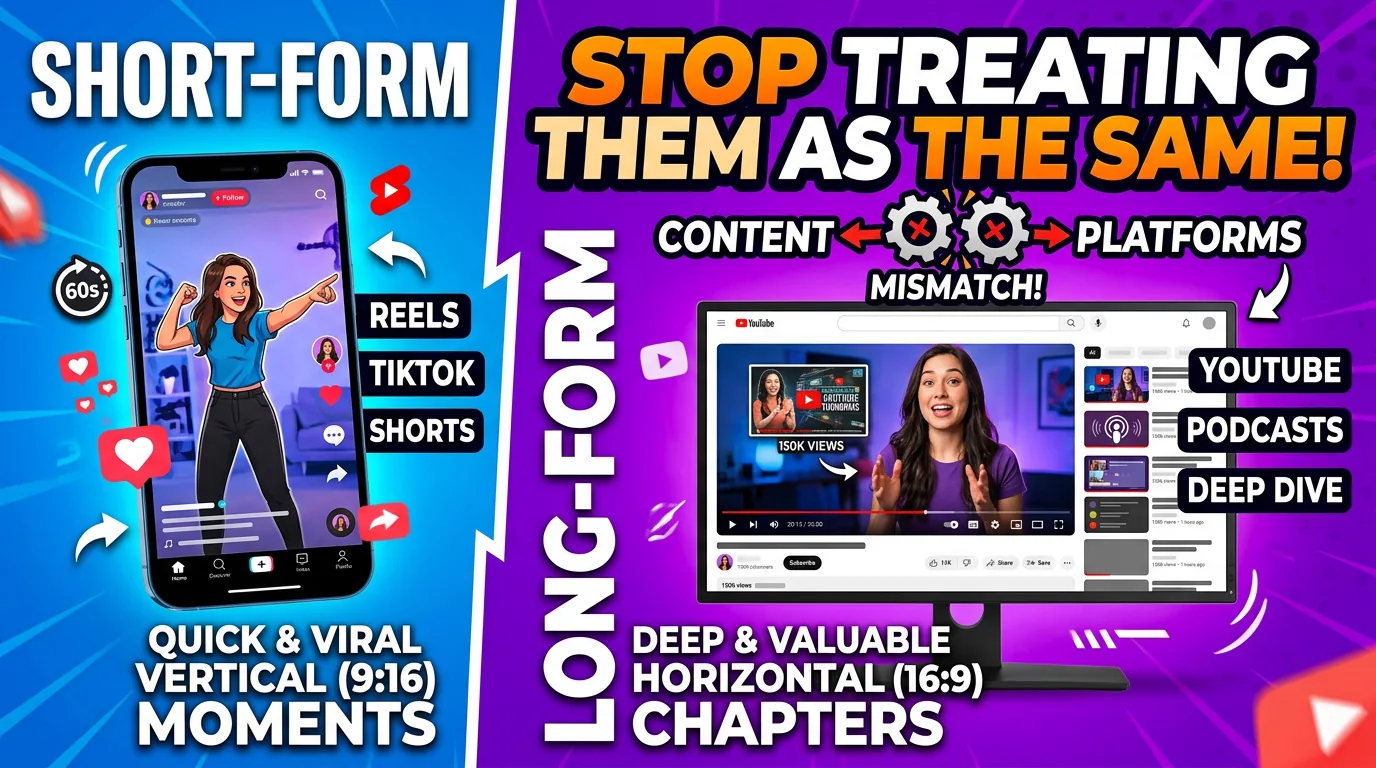
Short-Form vs Long-Form: Stop Treating Them as the Same Content
The most expensive habit in social video is treating short-form as a compression of long-form. It is not a smaller version of the same thing. It is a different product with a different job.
What each format is actually for
Long-form answers "how" and "why". The viewer arrived with a question and a willingness to spend twenty minutes on the answer. Your job is to be complete, correct, and well-organised.
Short-form answers "what". The viewer did not arrive with a question. They are scrolling. Your job is to create the question in the first second, then answer it fast enough that they stay to the end.
That difference changes everything about the edit.
The cut-down instinct, and why it fails
Take a thirty-minute tutorial and cut the best three minutes. You will usually get something that:
- •starts mid-sentence, because the setup was in the discarded part
- •uses vocabulary the viewer has no context for
- •ends on an explanation rather than a payoff
- •assumes patience the short-form viewer does not have
Every one of those is a symptom of the same error: the cut-down preserves the structure of the original. Short-form needs its own structure, built from scratch.
Build the short first, then the long
The counter-intuitive fix that works better than any cutting strategy: write the short first.
Take the single most interesting sentence in your subject — the one fact that made you want to make the video — and build a 45-second piece around it. Open on the claim. Prove it. End.
Nine times out of ten, that short is now the spine of the long-form video too. The long version expands each beat of the short with the depth the format allows. You get two pieces that genuinely share a point of view, rather than one piece and its leftovers.
The vertical reframe is not the hard part
Most tools, CutFlux included, can take horizontal footage to vertical automatically — tracking the subject and keeping them in frame as they move. That solves framing.
It does not solve pacing. A vertical 9:16 video wants a cut roughly every 1.5–2.5 seconds. Horizontal footage cut at that rate reads as frantic. If you are reframing long-form into vertical, the frame is the easy half; the rhythm is the work.
Captions are structure, not decoration
On a phone, a large fraction of viewers are watching with sound off. Captions are therefore not an accessibility feature bolted on at the end — they are the primary channel.
That means the words carry the timing. A caption that lands on the beat does more for comprehension than one that is technically accurate but drifts a half-second behind. Generate them from the transcript, then treat the timing as something to edit.
A practical split
If you are publishing to both formats, stop thinking in terms of a primary video and a derivative:
| Long-form | Short-form | |
|---|---|---|
| Opens with | context and promise | the claim, bare |
| Structure | chapters, progression | one idea, one arc |
| Cut rhythm | per idea (~5–15s) | per beat (~2s) |
| Ends with | a complete answer | a reason to want more |
The two columns share a subject. They do not share an edit. Treat them as separate productions and both get better — and the cut-down instinct stops costing you the audience you were trying to reach.