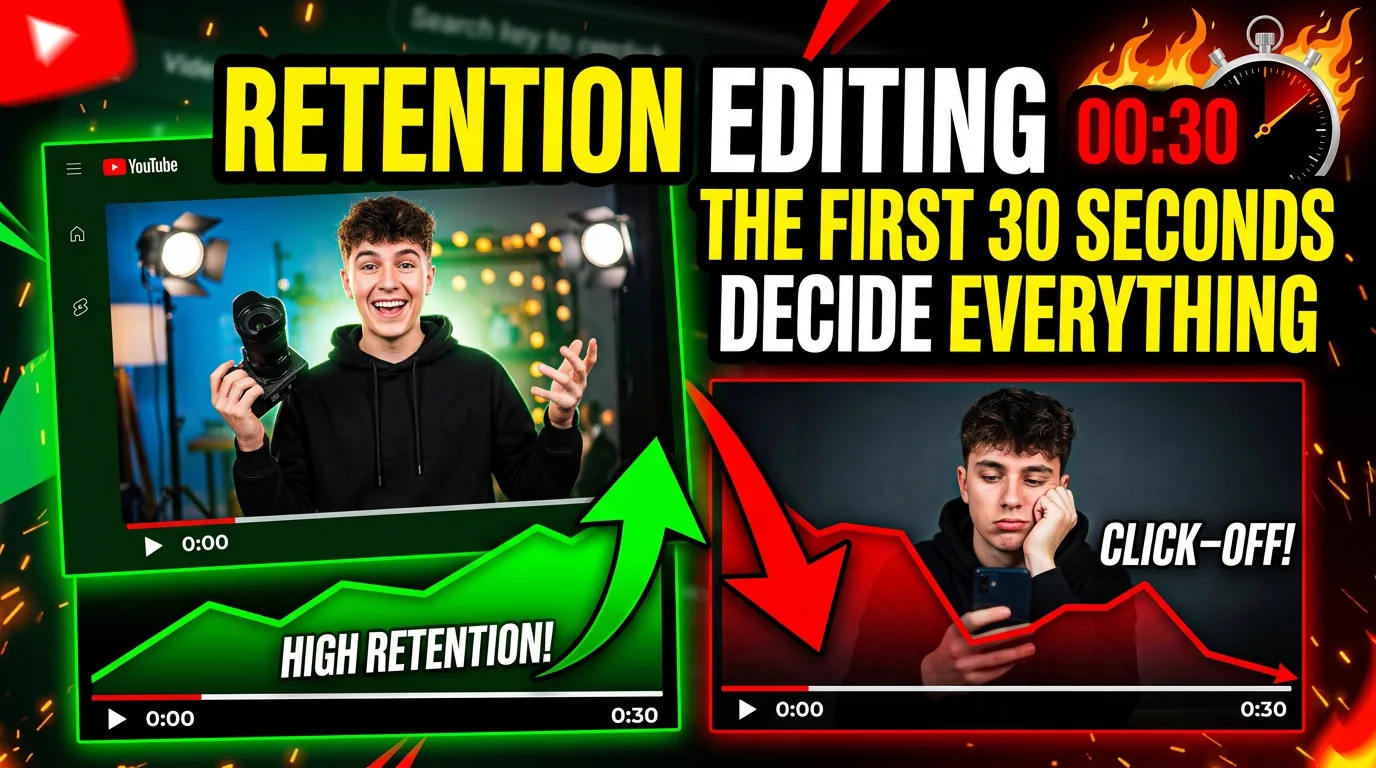
YouTube Retention Editing: The First 30 Seconds Decide Everything
Retention graphs are usually read wrong. People look at the drop-off and conclude the topic was boring. Far more often, the topic was fine and the edit failed to make the promise that the title and thumbnail already made.
The opening thirty seconds are not an introduction. They are the payment on a debt you took out when someone clicked.
The four openings that lose people immediately
Almost every retention collapse in the first minute is one of these:
- •The channel intro. A five-second animated logo before any content. It tells the viewer this video is about you, not about them.
- •The restated title. "In this video, I'm going to show you how to..." They already read the title. They clicked it. Repeating it is a delay, not a setup.
- •The apology or caveat. "Sorry the audio is a bit weird today." Now that is the thing they are listening for.
- •The slow context build. Thirty seconds of backstory before the first useful sentence.
Each one has the same shape: it puts the payoff further away than the click implied.
Lead with the result, then explain the method
The strongest opening states the outcome in the first sentence, shows it, and then earns the right to explain it.
"This clip got 400,000 views. It took eleven minutes to make. Here is exactly what I did, in order."
That is a complete contract. The viewer knows what they will have at the end, and roughly how long it will take to get there. Everything after it is delivery.
Cut on the idea, not on the breath
The most common technical habit that hurts retention is cutting where the speaker paused rather than where the point landed.
A speaker breathes constantly. They complete a thought far less often. If you cut on breath, you produce a video that feels busy and says nothing. If you cut on the idea, the pace feels deliberate even when the cuts are less frequent.
In practice: watch the transcript, not the waveform. Mark the sentence that completes each point, and let the pause after it stay.
Remove every second that does not advance the promise
Once the opening is fixed, the rest of the work is subtraction. The test for any clip is not "is this good?" but "does the video still make sense without it?"
- •Tangents that are interesting but off-topic: cut.
- •Setup for a joke that lands weakly: cut the setup and the joke.
- •Repeated explanations of the same idea in different words: keep the best one.
A tighter video is almost always a higher-retention video, because every remaining second is carrying weight.
Where CutFlux fits
The Smart Trim pass is built for exactly this. It finds the silences and the filler, proposes the cuts, and leaves the decision with you — so the subtractive work is a review pass rather than a manual scrub through twenty minutes of footage.
For the opening specifically, work in the transcript view. It is much easier to see that your first three sentences are throat-clearing when they are written down as three separate lines than when they are spread across a timeline.
The measurement that matters
Do not judge the fix by average view duration alone. Watch the first thirty seconds specifically. A video whose curve holds flat to 0:30 and then decays normally has a working opening. A video that drops 40% in the first fifteen seconds has a title/thumbnail problem, or an opening that broke the promise — and no amount of editing later in the timeline will repair it.
Start there. It is the highest-leverage thirty seconds you will ever edit.